
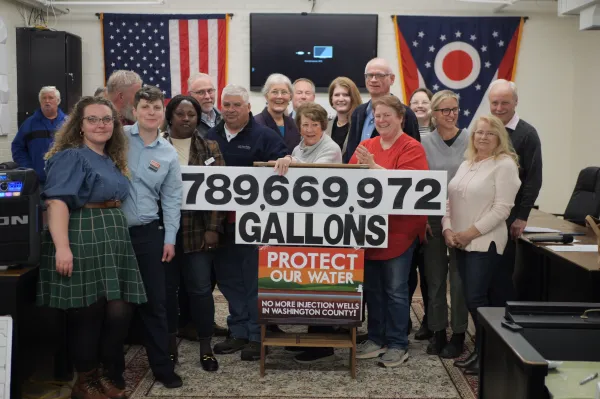
Following a series of historic actions on March 4th and 5th, a unified coalition from Washington County held a press conference and delivered a letter to Governor DeWine and the Ohio Legislature asking for a three year moratorium on Class I and Class II wastewater injection wells in the county. This movement has gained significant traction as local leaders and residents highlight the staggering volume of waste being pumped into the region and the risks to public health.
This unprecedented joint action represents an alignment of nine local authorities: the City of Marietta, the Village of Beverly, Muskingum and Waterford Townships, and the Warren, Putnam, Little Hocking, Highland Ridge, and Tri-County water boards. Together, these entities represent the water safety and infrastructure of over tens of thousands of residents who rely on local aquifers. They began the two day escalation by hosting a press conference at the Armory in Marietta on March 4th.
“This is the first time in Ohio, and maybe in the nation’s history, that this many water districts have gotten together to fight for our future,” said Marietta City Council President Susan Vessels. “And so, I think that there is hope, in this sort of ground swell, and we are showing what the community wants. We want safety, and we just have to hope that they listen to us in Columbus.”
The coalition is demanding an immediate pause on new permits and current waste injection while an independent, comprehensive study of local geology is conducted. The request follows years of reports of brine migration into local oil and gas production wells, with some owners reporting millions of dollars in losses and the loss of home heating. Since 2010, Washington County has been forced to accept over 2.8 billion gallons of oil and gas waste. This volume is roughly one fifth of the total volume for the entire state of Ohio, despite representing just 1.5% of the landmass of the state.
The events in Columbus on March 5th revealed how far state priorities have drifted from our local needs. While community members protested outside, State Senator Brian Chavez was inside an industry event receiving an "Oilfield Patriot Award." This celebration of the industry stands in direct opposition to the health and safety of the citizens he represents in Washington County. Senator Brian Chavez has been accused by his constituents in a recently filed ethics complaint of having a conflict of interest and close ties to the same companies who are injecting the waste under the ground he represents, while he sits as the energy chairman and has sponsored and fast-tracked legislation that could benefit the injection well industry and his family businesses while weakening oversight of the regulatory body.
After the protest, representatives from Washington County for Safe Drinking Water and Buckeye Environmental Network held a press conference at the Statehouse. A delegation then hand-delivered nine signed resolutions to the Governor’s office, carrying the voices of over 300 neighbors who are demanding protection for their water.
“The radioactivity brought to the surface in oil and gas development was never federally regulated and remains unregulated. The industry was granted a federal exemption in 1980 that legally defined their waste as nonhazardous, despite containing toxic chemicals, carcinogens, heavy metals and all the radioactivity,” stated Hillary Royster of Washington County for Safe Drinking Water.
“This action taken by local authorities in Washington County truly marks a historic moment in Ohio,” added Bev Reed of Buckeye Environmental Network. “How many other times have nine local authorities collectively called on state leadership regarding an issue like this? Ohio has been rapidly rubber stamping these injection wells too close to drinking water sources. It is past due for the state to pay attention to these folks and take a pause. As the local water authorities have continually stated: once the damage is done, there is no going back.”
Local leaders also expressed concern that while the industry is being celebrated, water associations are facing massive potential costs. Little Hocking Water Association already spends $120,000 four times a year to filter out forever (PFAS) chemicals, and they estimate it would cost $50 million to develop a new well field if their current aquifers are contaminated by oil and gas wastewater.
The nine signed moratorium resolutions are now posted to the City of Marietta website for public viewing.
Recent Media Coverage:
Cleveland.com: Southeast Ohio officials seek ban on injecting fracking wastewater underground
Farm and Dairy: Washington County water utilities join fight to stop injection wells
WTAP News: Washington County officials, residents demand moratorium on injection wells
WESA News: Water districts in Ohio join call for injection well moratorium | 90.5 WESA
Cleveland.com: Rural Ohioans finally fight against poisonous fracking waste the legislature has welcomed
For More Information on Injection Wells & Their Uses:
Rolling Stone & DeSmog: The Oil Industry’s Latest Disaster: Trillions of Gallons of Buried Toxic Wastewater - DeSmog
Watch the Event Videos:
Marietta Press Conference (March 4th): https://www.youtube.com/watch?v=pINFPHul3Uc
Columbus Press Conference (March 5th): https://youtu.be/yLjmxWr9i-g
Protest of Senator Brian Chavez (March 5th): https://youtu.be/62MCTr8eYrI
View the Resolutions: https://www.mariettaoh.net/government/city_council/agendas_and_minutes.php#outer-2077
About Buckeye Environmental Network: Buckeye Environmental Network is a grassroots organization dedicated to protecting the health and future of Ohio communities. We believe that every neighbor has the right to clean air, safe drinking water, and a say in the industrial practices that affect their home.